Application engineering

Hypertherm Service Decisions Start with the Workpiece

Our review path converts a production problem into observable inputs: alloy, thickness, cut geometry, pierce count, edge acceptance, extraction, controller signals and available utilities. Those inputs define what should be tested and what remains outside the claim.

Build the brief
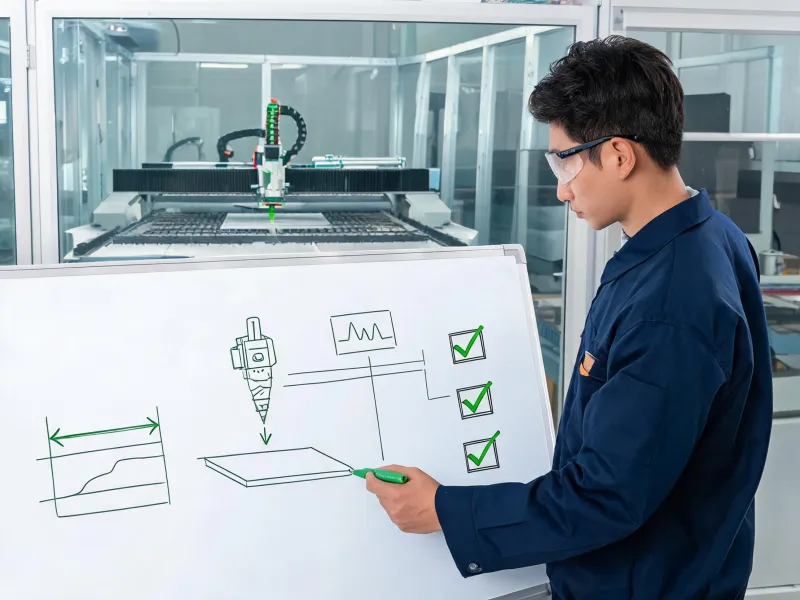
Application engineer mapping a plasma cutting process
Defined handoffs

Engineering work products that another shift can use

A service engagement is useful when it leaves behind a repeatable decision record. Each work product below has a stated input, an observable output and a boundary that prevents the record from being treated as a universal guarantee.

01 / Material trial

Cut coupon plan

The trial matrix records material grade, thickness, surface condition, consumable set, current, speed, pierce routine and torch-to-work control. Samples are labeled before inspection. Edge angle, dross tendency and visible heat effect are compared under the actual shop utilities.

02 / Interface

Cell signal review

Application engineers map start, transfer, motion enable, arc voltage and fault-handling signals between the plasma source, CNC, height control and table. The review identifies ownership of each interlock; it does not certify the integrator's electrical design.

03 / Qualification

Process-window record

A bounded range is written for the tested plate, consumables and motion platform. The record includes the acceptance sample, inspection method and restart checks. Changes in alloy, coating, air quality or table mechanics trigger a new confirmation rather than silent reuse.

04 / Maintenance

Condition-based handoff

Operators receive inspection points for torch alignment, nozzle orifice condition, electrode wear, gas or air delivery, work lead integrity and height-control behavior. Intervals are adjusted from observed pierce count and edge trend, not from an invented universal lifespan.

Review questions

What changes the recommendation?

The answers below expose trade-offs that are often hidden by a simple amperage comparison. The application team uses them to decide whether a short remote review is sufficient or a controlled trial is needed.

Higher current can expand capacity, but the cell must also manage pierce energy, motion stability, extraction and consumable condition. A faster straight cut may not reduce total cycle time if starts, corners or secondary grinding dominate.

Published values are a starting point. Plate chemistry, coating, input power, compressed-air quality, table motion and torch height can shift the result. A labeled coupon remains the practical confirmation route.

Escalate when the fault is intermittent, involves safety interlocks, repeats after consumable replacement, or cannot be separated from CNC, table, gas and extraction behavior. De-energization and qualified electrical procedures remain mandatory.
Before / after the review

A machine symptom becomes a testable process statement

Unbounded request

"The cut is bad on thick plate." The statement gives no grade, thickness, edge direction, consumable history, speed, pierce behavior or inspection method. Several independent causes remain mixed together, and replacement parts become guesswork.

  • No retained sample
  • No controller event sequence
  • No utility measurement
  • No acceptance threshold

Engineering brief

"Dross increased on the second shift while cutting the same labeled mild-steel lot. Consumables passed visual inspection; pressure at flow and torch-height trend are attached." The evidence narrows the next check and preserves the production context.

  • Traceable coupon and settings
  • Signal and alarm timeline
  • Pressure and input-power context
  • Agreed edge inspection points
Start with evidence

Send the conditions that define the cut.

Include a drawing or cut description, material and thickness range, expected production volume, current table or hand process, available power and air or gas supply, plus the edge condition that the next operation requires.

Application review does not replace machine guarding, qualified electrical work, local fume controls or a procedure qualification required by the governing code.

Enter your name.
Enter a valid business email.